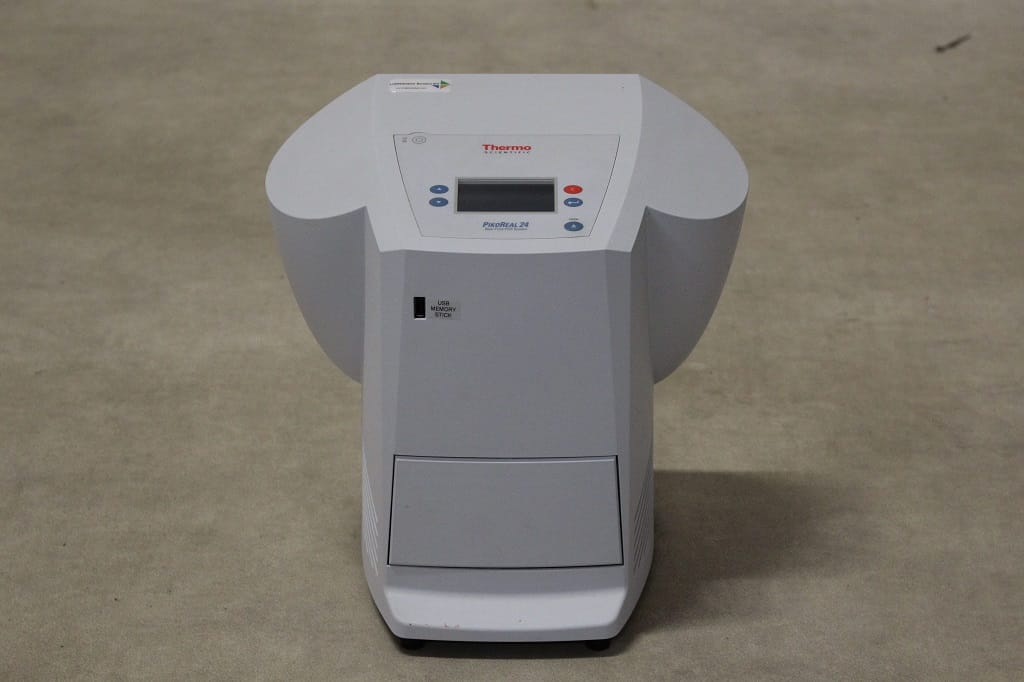
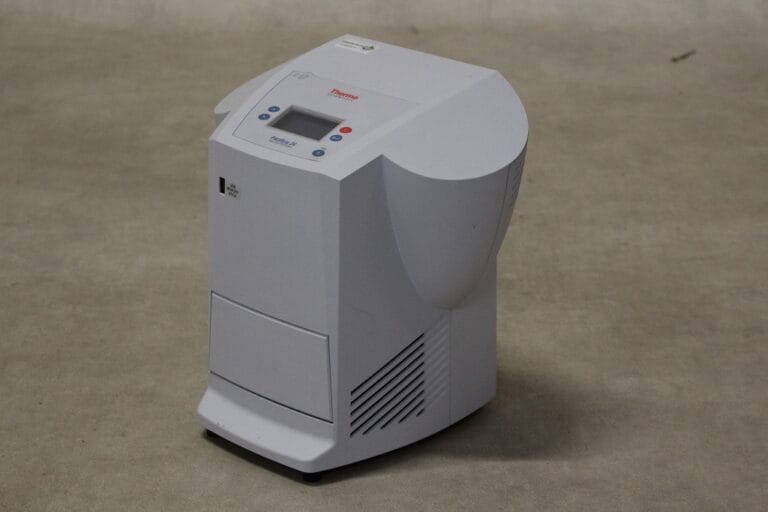
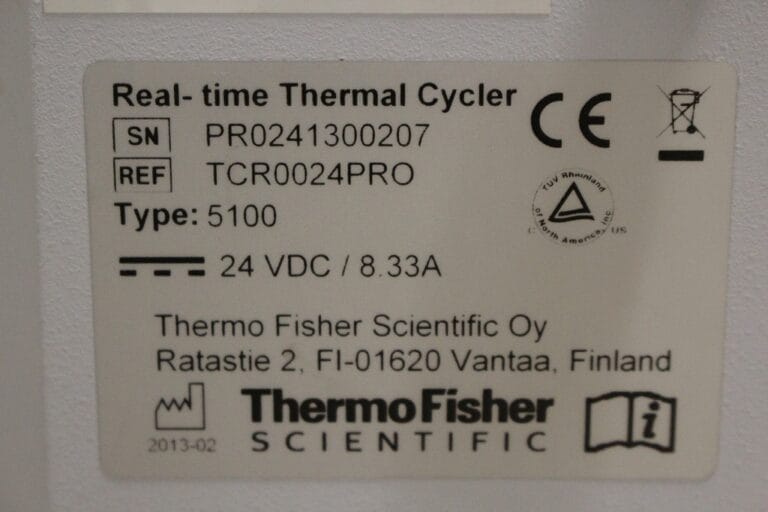
Thermo PikoReal 24 Thermal Cycler
Product code: 48169124
Details
Description
The Thermo Scientific PikoReal 24-cycler is ideal for starting real-time PCR with low sample throughput (24-well format). The PikoReal software provides simple and intuitive operation of the cycler and allows easy online control from your computer. The cycler has 5 detection channels, which detect hydrolysis (5'Nuclease / TaqMan) probes as single-color or multiplex samples.
Thermal block
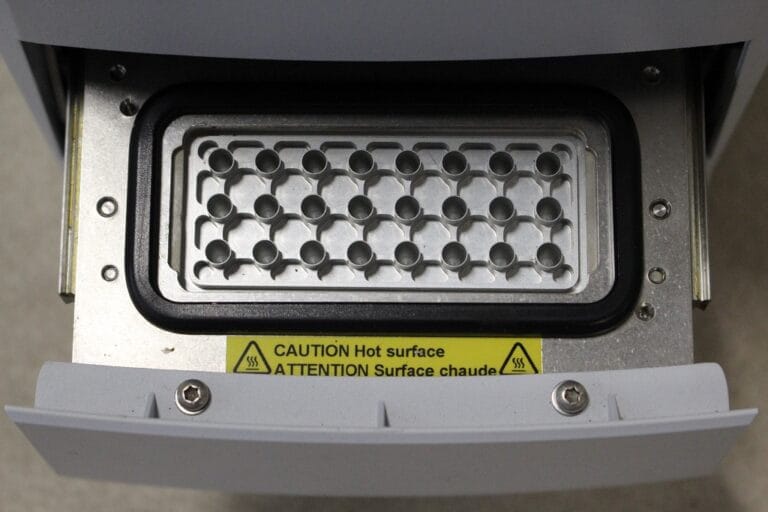
Block size: 24 wells
Sample volume: 10 - 50 μl
Consumables: low profile strips and PCR tubes
Max heating rate: > 5°C/sec
Max cooling rate: 4.5°C/sec
Temperature range: 4-99.9°C
Temperature accuracy: ±0.2°C
Temperature uniformity: ±0.3°C at 95°C, ±0.15°C at 60°C, ±0.2°C at 72°C
Heated lid
Temperature range: 50-110°C
Control: Automatic temperature and pressure setting
Optics
Excitation: 5 LEDs
Excitation range: 475-640 nm
Detection: CCD
Detection channels
Channel 1 - Excitation: 475-500nm, Emission: 520-550nm, Pre-calibrated dyes: FAM
Channel 2 - Excitation: 515-535nm, Emission: 557-590nm, Pre-calibrated dyes: HEX, Yakima Yellow
Channel 3 - Excitation: 570-590nm, Emission: 615-650nm, Pre-calibrated dyes: ROX, Texas Red
Channel 4 - Excitation: 600-640nm, Emission: 666-740nm, Pre-calibrated dyes: Cy 5
Channel 5 - Excitation: 475-500nm, Emission: 520-590nm, Pre-calibrated dyes: SYBR Green
Multiplex: up to 4 targets
Dynamic Range: 10 logs
Sensitivity: 1 copy
Analysis modes
Absolute quantification; Relative quantification; Melt curve
analysis; Allelic discrimination; High resolution melt (HRM)
Stand-alone or PC control:
The PikoReal qPCR system is controlled by PikoReal software, which allows remote monitoring of any qPCR experiment online from your own computer. Alternatively, you can save the qPCR protocol on a USB stick and load to the PikoReal instrument for stand-alone use.
PikoReal software include modules for absolute and relative quantification, melting curve analysis, allelic discrimination and High Resolution Melting (HRM). Advanced algorithms provide effortless data normalization without the need for an external reference dye.